 EN
EN

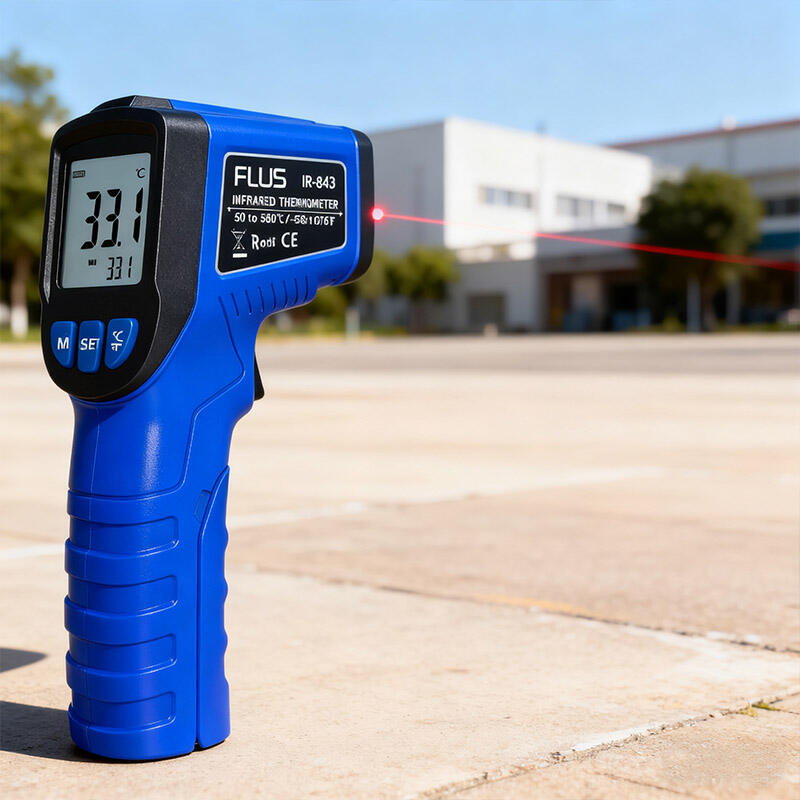
Understanding the Distance-to-Spot Ratio and Its Role in Accuracy
What Is the Distance-to-Spot Ratio (D/S Ratio)?
When talking about laser thermometers, we need to understand what the distance-to-spot (D/S) ratio really means. Basically, it shows how far away the device can be while still measuring an accurate temperature on a specific sized area. For instance, if a thermometer has a 12:1 ratio, then at 12 inches away it will read temperatures from a spot roughly 1 inch across. Industry standards tell us that when working with these instruments, higher D/S ratios are definitely better because they allow for precise measurements even when standing back. This becomes super important in factories or plants where workers need to stay clear of dangerous heat sources but still get reliable temperature data without getting too close for comfort.
How the D/S Ratio Determines Measurement Accuracy at Various Distances
Getting accurate readings really comes down to sticking to the recommended distance-to-spot size ratio. Take a 30:1 thermometer for example it needs to be no more than 60 inches away from something that's just 2 inches across. When we go past that mark, the sensor starts picking up heat from surrounding areas instead of just what we want to measure. This kind of mixed signal creates errors that might swing as much as plus or minus 5 percent according to research from Ponemon back in 2023. Keeping within those guidelines makes sure the infrared technology actually locks onto the right spot without interference from nearby objects or surfaces.
Common D/S Ratios in Consumer vs. Industrial Laser Thermometers
| Device Type | Typical D/S Ratios | Ideal Use Case |
|---|---|---|
| Consumer Models | 8:1 to 12:1 | Cooking, HVAC maintenance |
| Industrial Models | 30:1 to 50:1 | High-voltage systems, furnaces |
The Science Behind Infrared Detection and Spot Size Precision
Infrared thermometers detect thermal radiation within their optical field of view. Higher D/S ratios allow for smaller spot sizes at longer distances. Research shows that a 50:1 device can identify 0.5°C variations in a 1 cm² area from 50 cm away, demonstrating how advanced optics improve precision in critical applications.
Debunking the Myth: Laser Sights Don’t Define the Measurement Area
What people see as that red laser point isn't really showing exactly where measurements happen. The real story changes as things get further away because light spreads out naturally. Take a standard 12:1 ratio thermometer for instance. At close range it works fine, measuring about an inch across when held 12 inches from something. But back off to three feet away and suddenly that tiny spot becomes three inches wide instead. This spreading effect creates what looks like an oval shape rather than a perfect circle. Many folks don't realize their readings might actually include stuff they didn't mean to measure, particularly when working with objects farther away than expected.
Key Factors That Influence Laser Thermometer Performance at a Distance
Surface Emissivity and Its Impact on Remote Temperature Readings
How well a surface releases heat energy, known as emissivity, has a direct impact on measurement readings. Surfaces with low emissivity values, think polished metal surfaces, tend to bounce back surrounding thermal radiation rather than emit it themselves. This can throw off temperature measurements by as much as 20% when compared to materials with higher emissivity like rubber or asphalt pavement. Getting the emissivity settings right matters a lot, especially where different materials are mixed together in an environment. Industrial facilities that failed to account for these differences saw nearly $2.1 million lost each year due to measurement errors according to research published by Meskernel in 2023. Proper calibration isn't just about numbers on a screen it's about preventing costly mistakes in real world applications.
Environmental Interference: Dust, Humidity, and Ambient Temperature Effects
Atmospheric conditions significantly impact performance. Dust and humidity scatter infrared signals, reducing precision by 5–15%. Humidity levels above 60% distort wavelengths, while ambient temperatures below 10°C (50°F) reduce effective detection range. To maintain accuracy, devices need compensatory algorithms—missing in 78% of consumer models—when operating under ±5°C temperature fluctuations.
Optical Obstructions and Atmospheric Conditions in Long-Range Use
When measuring beyond around 30 meters, changes in air density affect how light bends through the atmosphere, which can shift the actual measurement point anywhere from about 10 to maybe even 20 centimeters off target, especially when there's light fog hanging around or those annoying heat waves on hot days. This kind of error becomes a real headache for anyone trying to monitor power lines accurately. Most field workers know better than to push their equipment right up to the specs listed in the manual. Instead they tend to work within roughly half of what manufacturers claim as maximum distance just so they can maintain that critical plus or minus 1 degree Celsius accuracy needed when weather conditions aren't cooperating.
Best Practices for Accurate Distance-Based Measurements
How to Calculate Maximum Effective Distance Using the D/S Ratio
Use the D/S ratio to determine the farthest usable distance for reliable readings. Apply the formula:
Maximum Distance = D/S Ratio × Target Diameter
| D/S Ratio | Minimum Target Size | Effective Distance |
|---|---|---|
| 8:1 | 2 inches | 16 inches |
| 50:1 | 0.5 inches | 25 inches |
Technicians using this method reduced measurement errors by 63% compared to estimation (2024 thermography study). Always confirm your device’s D/S ratio in its specifications.
Tips for Measuring Small or Distant Targets with a Laser Thermometer
For optimal results on small or distant targets:
- Steady targeting: Use tripods or stabilizers to prevent hand movement
- Background contrast: Avoid shiny or reflective backgrounds that interfere with infrared detection
- Calibration checks: Recalibrate monthly using reference standards, as research shows uncalibrated units drift by ±2°C within 90 days
Avoiding Common Distance-Related Errors in Field Applications
Environmental factors account for 78% of long-range measurement failures (Journal of Thermal Imaging, 2023). Minimize errors by:
- Clearing dust, steam, or obstructions before scanning
- Aiming perpendicular to the surface to avoid cosine error
- Adjusting emissivity settings based on material type
Field teams following these practices achieve 92% first-attempt accuracy in industrial diagnostics.
Real-World Applications of Proper Distance Measurement in Industry
HVAC Maintenance: Taking Safe, Accurate Readings from a Distance
When checking duct temps or spotting hot spots on electrical panels, HVAC techs rely on laser thermometers that have the right distance-to-spot size ratio. For instance, a 12:1 ratio means they can get an accurate reading of something about 2 inches wide even when standing 24 inches back from it. This matters a lot when working close to live circuits where safety is paramount. The latest Industrial Safety Report from 2024 backs this up, showing how important these devices really are for preventing accidents in tight spaces while inspecting commercial systems. Techs know firsthand that getting good readings without risking exposure makes all the difference in their daily work.
Food Safety Inspections Using Correctly Calibrated Laser Thermometers
Regulatory standards require temperature measurements within a <2°F margin of error for refrigeration units and cooking surfaces. With 20:1 D/S ratios, inspectors can verify conditions across large freezers up to 15 feet wide without entering cold zones. Regular calibration maintains accuracy despite humidity swings common in food processing facilities.
Electrical System Monitoring Without Direct Contact
Long-range models with 50:1 D/S ratios enable utilities to scan high-voltage equipment from over 10 feet away. This non-contact approach reduces arc flash exposure by 76% compared to manual checks, aligning with NFPA 70E safety protocols. Studies show these tools also accelerate fault detection by 40% in substation and grid monitoring scenarios.
Medical Screening Limitations of Long-Range Infrared Thermometers
Long range infrared thermometers have become pretty common for checking fevers during public health crises, but they start losing their medical accuracy once someone steps back past about three feet. According to the Food and Drug Administration, thermometers meant for close up readings (like those with a 1 to 1 distance to spot size ratio) can be off by as much as plus or minus 1.8 degrees Fahrenheit when trying to measure forehead temperature from six feet away. This kind of error margin creates real problems when trying to control infectious diseases because getting an accurate reading matters a lot in these situations.
Innovations Enhancing Distance Accuracy in Modern Laser Thermometers
Dual-Laser Targeting for Clearer Spot Size Indication
Dual laser systems work by sending out two parallel beams that create a visual boundary around what's being measured. This helps fix a common misunderstanding people have when they think one small red dot means they're pointing right at the target. Take a device with a 20:1 distance to spot size ratio for instance it can read measurements across a 2 inch diameter area from 40 inches away, with those twin beams showing exactly where the sensor is actually looking. Real world tests indicate these dual beam models cut down on aiming errors by as much as 70 percent when compared to older single beam technology according to findings published in last years Precision Laser Tech report.
Smart Sensors with Bluetooth and App-Based Distance Compensation
Advanced sensors now connect via Bluetooth to mobile apps that adjust readings in real time for distance, humidity, and surface emissivity. These smart systems enhance accuracy by ±1°C in challenging environments like outdoor HVAC assessments. A 2023 study found technicians using app-enhanced laser thermometers completed electrical inspections 25% faster with 99% consistency.
Higher Optical Resolution and Advancements in D/S Ratios
Today's infrared optics can achieve D/S ratios as high as 50:1 even in basic consumer models, which represents about 150% better performance compared to what was available back in 2019. These units typically come with multi element germanium lenses paired with 640 by 480 pixel detectors, allowing them to detect temperature differences down to just 0.1 degrees Celsius from a distance of 100 feet away. The phase shift tech built into many systems helps boost distance calculations too, keeping accuracy within plus or minus 1 percent over standard 30 meter distances. Such fine resolution makes it possible to monitor tiny industrial components safely and accurately, like watching those little circuit breakers on factory floors without having to get dangerously close.
FAQ
What is the distance-to-spot ratio in laser thermometers?
The distance-to-spot ratio in laser thermometers shows how far away the device can be while still measuring an accurate temperature on a specific sized area.
Why are higher D/S ratios deemed better for measurements?
Higher D/S ratios allow for precise measurements at longer distances, which is vital in environments where workers must maintain a safe distance from heat sources.
Do the red laser points show the exact measurement area?
No, the red laser point does not show exactly where measurements happen. The spot size changes as the distance increases due to light spread.
How does surface emissivity affect temperature readings?
Surface emissivity, or how well a surface emits heat, affects the accuracy of temperature readings. Low emissivity surfaces, like polished metals, can reflect surrounding thermal radiation, distorting readings.
What are some innovations enhancing the accuracy of modern laser thermometers?
Innovations like dual-laser targeting, smart sensors with Bluetooth, and enhanced optical resolutions have been introduced to improve the accuracy of modern laser thermometers.
Table of Contents
-
Understanding the Distance-to-Spot Ratio and Its Role in Accuracy
- What Is the Distance-to-Spot Ratio (D/S Ratio)?
- How the D/S Ratio Determines Measurement Accuracy at Various Distances
- Common D/S Ratios in Consumer vs. Industrial Laser Thermometers
- The Science Behind Infrared Detection and Spot Size Precision
- Debunking the Myth: Laser Sights Don’t Define the Measurement Area
- Key Factors That Influence Laser Thermometer Performance at a Distance
- Best Practices for Accurate Distance-Based Measurements
- Real-World Applications of Proper Distance Measurement in Industry
- Innovations Enhancing Distance Accuracy in Modern Laser Thermometers
-
FAQ
- What is the distance-to-spot ratio in laser thermometers?
- Why are higher D/S ratios deemed better for measurements?
- Do the red laser points show the exact measurement area?
- How does surface emissivity affect temperature readings?
- What are some innovations enhancing the accuracy of modern laser thermometers?